Showing posts with label old west. Show all posts

Wednesday, April 08, 2009

And The Winner Is... Chud Tsankov!

The winner for the "Old West" challenge is:

Chud Tsankov!

Congratulations to Chud Tsankov. I chose Chud Tsankov's "Sheriff with gun on horse" as the winner. I can't believe that this is Chud's first win! Chud has a fantastic cartooning style, much like the indy styles of the late sixties, early seventies, but unique and distinct. One can imagine these drawing animated - I hope some day they are. Keep 'em coming, artists! Lots of awesome work!

Friday, April 03, 2009

Old West

When I first heard of this week's challenge, I quickly sketched out a concept I thought would be good. Here is my original drawing.

Then I tried to do an illustration which didn't exactly turn out as I had hoped. It just never captured the raw power of my original. So then I though I would just combined the sketch with some additional vector art and some raster effects. The result is below.

I think I still prefer my original concept sketch. What do you think?

Ole West

I always found it hard to take anyone seriously who wears a vest and chaps.

Just a little sketch...would have liked to have finished...Deadlines, Deadlines, DEAD----lines.

Friday, March 27, 2009

The Old West


A native Indian girl reading about the old west.
I blog at mydailyartwork

OLD WEST (bathtub or troft?)

Wednesday, March 25, 2009

Wyatt Urp

High noon at the OK corral.

From a really old sketch I did as part of a greeting-card submission. From rough sketch to finished art this one was almost 15 years in the making...good thing I didn't have a deadline.

My Blog

© 2009 Barry/Right-Hemisphere Laboratory

Tuesday, March 24, 2009

old west (part 2)

The current challenge on Monday Artday is "the old west". In addition to my finished illustration, I included my original pencil sketch. (I showed a pencil sketch once before on this post.)
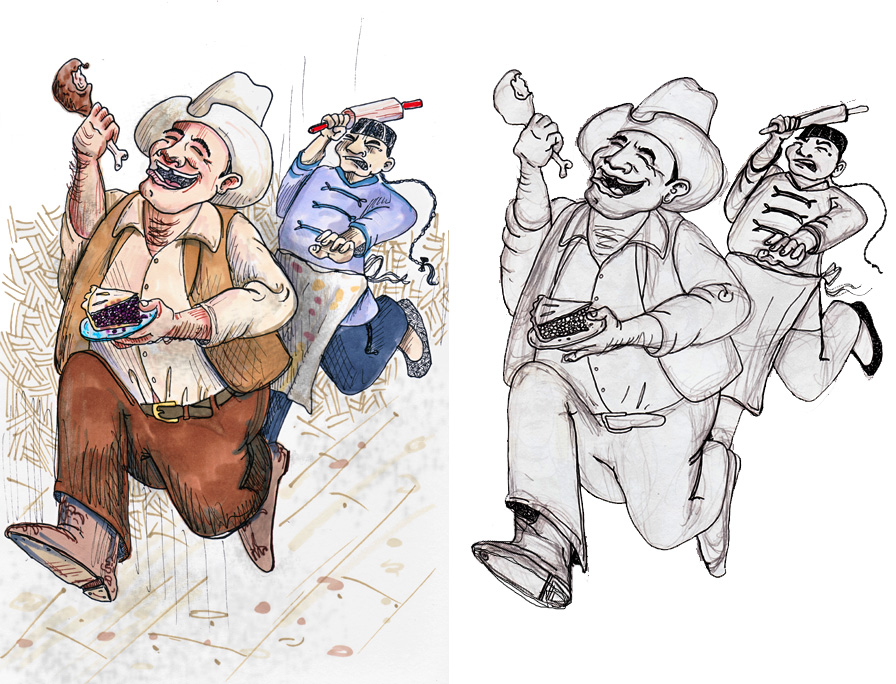
we got a right to pick a little fight
When I did an illustration for "the old west" in 2007, I presented a rather somber subject. This time, I'm taking a more light-hearted route. Well, it has a terrible ending, but there's some fun before I get there.
Read the rest of this story HERE on my blog.

The Old West

Looks like the Old West has come a long way baby.

Monday, March 23, 2009

Sheriff with gun on horse


Cowgirl

old cowgirl illustration I did

old west

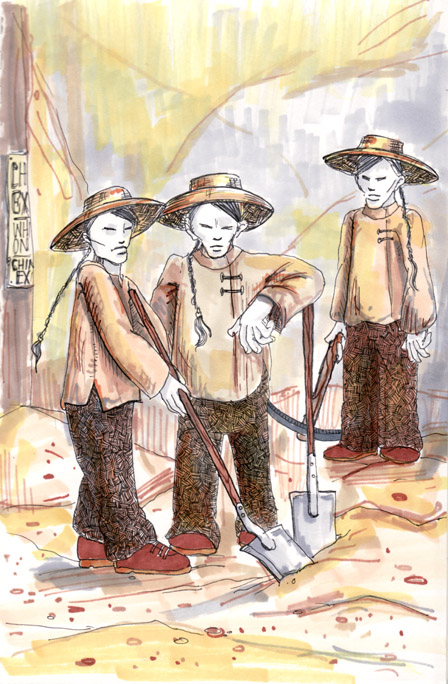
I've been exploited on the railroad/All the live-long day
This week's challenge is "old west". I actually did this illustration two years ago for another illustration blog to which I used to contribute. It is one of my favorites. I will most likely submit a new drawing for the challenge, but, in the meantime...

The heyday of the American "Old West" was roughly the time between the years 1865 to 1890. These times bring to mind romantic stories of cowboys and gunfights, of John Wayne and Roy Rogers, of saloon dancers and wagon trains. But this is a Hollywood version of the "Old West". There is another "Old West" that this country would rather forget.
The Transcontinental Railroad was completed in 1869. It was the beginning of a nation-wide linking of railways. It was a major factor in the building and strengthening of the United States. Because it was such a massive undertaking, laborers were scarce. Thousands of Chinese immigrants, who came to the US during the Gold Rush in 1849 and had a reputation as hard workers, were recruited by the railroad companies to build the railroads. The Chinese were hired to keep labor costs down, as they were paid about one-third of white laborers' salary. Plus, they had to provide their own food and pay for their own living expenses, benefits that were covered for the white workers by the railroad companies.
Thirteen thousand Chinese workers dug tunnels and laid track for half of the Transcontinental Railroad. In photos and illustrations depicting the "Golden Spike" ceremony at Promontory Point, Utah, the site of the joining of the East and West railroad, the Chinese are conspicuously absent.
As a reward and thanks for Chinese efforts, the United States passed the Chinese Exclusion Act of 1882. This act outlawed all Chinese immigration to the United States and denied citizenship to those already settled in the country. Official discrimination extended to the highest levels of the U.S. government: in 1888, U.S. President Grover Cleveland, who supported the Chinese Exclusion Act, proclaimed the Chinese "an element ignorant of our constitution and laws, impossible of assimilation with our people and dangerous to our peace and welfare."

Sing it, Lee Greenwood.

Thursday, August 02, 2007

old west


This week's word(s) at another illustration blog (that almost kicked me off) is "old west". The heyday of the American "Old West" was roughly the time between the years 1865 to 1890. These times bring to mind romantic stories of cowboys and gunfights, of John Wayne and Roy Rogers, of saloon dancers and wagon trains. But this is a Hollywood version of the "Old West". There is another "Old West" that this country would rather forget.

The Transcontinental Railroad was completed in 1869. It was the beginning of a nation-wide linking of railways. It was a major factor in the building and strengthening of the United States. Because it was such a massive undertaking, laborers were scarce. Thousands of Chinese immigrants, who came to the US during the Gold Rush in 1849 and had a reputation as hard workers, were recruited by the railroad companies to build the railroads. The Chinese were hired to keep labor costs down, as they were paid about one-third of white laborers' salary. Plus, they had to provide their own food and pay for their own living expenses, benefits that were covered for the white workers by the railroad companies.

Thirteen thousand Chinese workers dug tunnels and laid track for half of the Transcontinental Railroad. In photos and illustrations depicting the "Golden Spike" ceremony at Promontory Point, Utah, the site of the joining of the East and West railroad, the Chinese are conspicuously absent.


As a reward and thanks for Chinese efforts, the United States passed the Chinese Exclusion Act of 1882. This act outlawed all Chinese immigration to the United States and denied citizenship to those already settled in the country. Official discrimination extended to the highest levels of the U.S. government: in 1888, U.S. President Grover Cleveland, who supported the Chinese Exclusion Act, proclaimed the Chinese "an element ignorant of our constitution and laws, impossible of assimilation with our people and dangerous to our peace and welfare."


Sing it, Lee Greenwood.